
The Best Spanish TV Shows to Learn Spanish, and How to Actually Learn From Them
The language I did this to myself in was Dutch, not Spanish. For about a year I told myself that watching TV in my target language was studying. I would put on a series in the evening, switch on the English subtitles, and feel productive. Then I noticed something uncomfortable. I was reading the English the whole time. My ears were off. I could have watched the same hour on mute and lost nothing.
That mistake is not Dutch. It is what almost everyone does with Spanish too, and Spanish makes it easier to get away with, because there is so much good television that you can spend a year feeling like you are learning. This is the guide I wish someone had handed me: the shows worth your time at each level, where you can actually watch them, and the one change that turns an evening on the sofa into real progress.
The short answer
The best Spanish show to learn from depends on your level. Beginners do well with shows made for learners, like Extr@ or Destinos. Intermediate learners around B1 want slow, clear drama like Yo soy Betty, la fea, or real street Spanish from the Easy Spanish channel, then La Casa de Papel as a stretch. Whatever you watch, switch to Spanish subtitles as soon as you can, and watch on purpose rather than in the background. TV only teaches you the Spanish you actively follow.
Can you really learn Spanish from TV?
Yes, and Spanish gives you a better shot at it than almost any language, which is exactly where the trouble starts. Spanish is one of the most heavily produced television languages in the world, with its own industries in Spain, Mexico, Colombia and Argentina, so you will never run out of material. Most learners of smaller languages fight scarcity. You fight abundance, and abundance makes it very easy to keep consuming forever without ever being forced to stop and work something out.
The evidence for the format itself is decent. A 2013 meta-analysis by Maribel Montero Perez and colleagues pooled ten studies and found a medium-to-large effect on vocabulary from watching video with same-language captions. Note the condition buried in that sentence: same-language. It is the part almost everyone skips, and in Spanish it is genuinely harder to get right than it sounds, for reasons in the subtitles section below.
Best Spanish TV shows for beginners (A1 to A2)
Spanish has something Dutch does not: a small set of series written specifically to teach the language, made back when television was how languages got taught. They look dated. They are also far more useful in your first year than any Netflix drama, because the speech is slow on purpose and the useful phrases come round again.
Do not measure yourself against an adult native speaker at this stage. The goal is narrower and more useful: get your ear used to where Spanish puts its stress, and start catching the same two hundred words often enough that they stop needing translation.
Best Spanish TV shows for intermediate learners (B1 and up)
Once you are around B1, the teaching series start to feel slow and you are ready for Spanish made for native audiences, as long as it is the conversational kind rather than fast slang-heavy drama. This is the level where most learners stall, so the choice matters more here than anywhere else.
If you take one thing from this section, make it the boring one: pick a single series where you catch most of it and stay with it. Familiar characters and repeated situations make the Spanish easier every episode, and that compounding is what a shuffled watchlist never gives you.
Spain or Latin America? Which Spanish to learn from
Pick the one you will actually use, then mostly stay with it while your ear is still forming. This is a real decision in Spanish in a way it is not in most languages, and it is also smaller than beginners fear.
The differences that matter for listening are the accent, a slice of everyday vocabulary, and whether people say vosotros or ustedes for "you" in the plural. Peninsular Spanish also pronounces the c and z sounds in a way Latin American Spanish does not, which is the first thing most learners notice. None of it makes the other half unintelligible, and educated speakers move between regions without difficulty.
The practical rule: if you are learning for Spain, weight your watching towards La Casa de Papel, Elite and Spanish public television. If you are learning for Latin America, or you have no particular destination, Yo soy Betty, la fea and Club de Cuervos are your spine. Once you are comfortably past B1, deliberately mixing regions is good for you. Before that, it just makes listening harder than it needs to be.
Where to watch Spanish shows (Netflix, RTVE Play, YouTube)
Three services cover almost everything on this page, and the choice between them comes down to what you are watching and which country you are in.
Netflix carries its own Spanish-language originals, including Club de Cuervos, La Casa de Papel and Elite, and it lets you switch between Spanish and English subtitles in a couple of clicks, which turns out to matter more than the catalogue size. Because these are originals rather than licensed titles, they tend to stay put.
RTVE Play is the Spanish public broadcaster's streaming service. It is free and it carries a deep archive of Spanish series and news, but it is geo-blocked outside Spain, so treat it as a watch-at-home option if you are in the country. YouTube is free everywhere and hosts the whole Easy Spanish channel, Peppa Pig en español, and circulating episodes of Extr@, so it is the easiest place to start with no subscription at all.
One honest caveat that most lists skip: streaming catalogues differ by country and shift every few months. Licensed titles like Yo soy Betty, la fea move between services, so check your own region rather than trusting any article's platform list, including this one.
Spanish or English subtitles? Three traps
Spanish subtitles beat English ones, for a reason worth knowing: same-language captions pin a sound to its spelling and show you where one word stops and the next starts, which is the specific thing a translation cannot do for you. But getting genuinely matched Spanish subtitles is harder in Spanish than in most languages. Three traps, in the order you will hit them.
The dub trap, and it is the big one. A large share of what you will find carrying Spanish audio was dubbed from English, and Spain in particular has a deep and very old dubbing industry. Dubbing is written to fit mouth movements and speech rhythm rather than to translate literally, while the Spanish subtitle track is usually a separate translation made from the original script. So the audio and the text say two different things, both in Spanish. You will conclude that your listening is failing when what is actually happening is that you are reading a different sentence from the one being spoken. This is why every show above is a Spanish-language original rather than a dub.
Castilian or Latin American track. Plenty of titles carry both, and they differ in everyday vocabulary and sometimes in verb forms. Match the subtitle track to the audio you picked, and stay with it. Mixing them is a quiet way to make everything feel harder than it is.
The speed problem. At B1 the Spanish subtitles often run past faster than you can process, so you fall back to English and stop learning. That is the real ceiling of the format, and it is the next section.
The working rule: English subtitles to enjoy something you could not otherwise follow, Spanish subtitles the moment you want it to count as practice, and a Spanish-original show so the audio and the text actually agree.
Why watching alone stalls, and what to pair it with
Television is built to be watched passively, and passive is the one mode that does not move you forward. It runs at a single speed that is not yours, and by the time you have worked out the word you missed, the scene has gone. That is not a flaw in the shows. It is the format.
The way past it is not a better series. It is pairing the watching with something you control: reading, at your own pace, on Spanish you picked yourself. Watching builds your ear and gives you no control. Reading gives you all the control and no sound. Put them together and each one covers the other's gap. I wrote the full argument up for Dutch in why you get stuck at B1, and none of the reasoning there is language-specific.
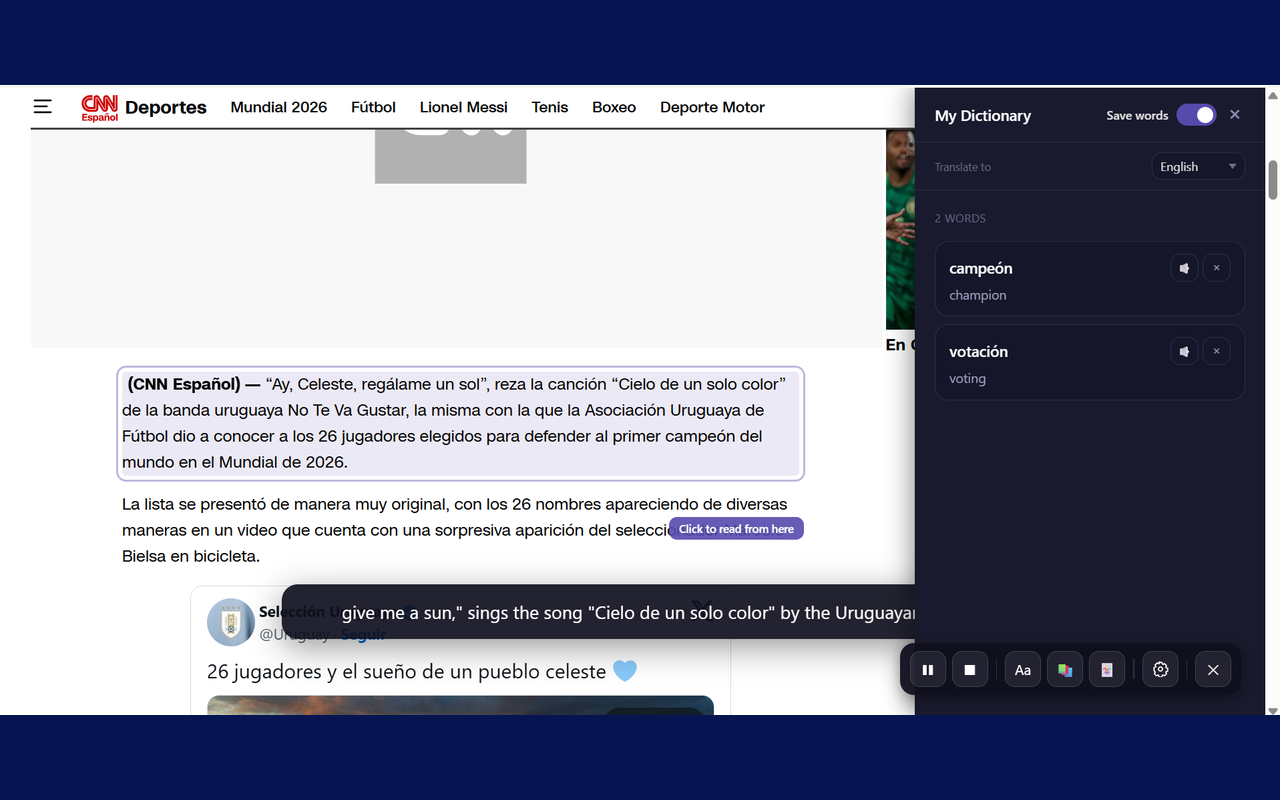
That reading half is the gap I built Verbally to fill. It reads any Spanish web page aloud in real Spanish with English captions in sync, so a recap of the episode you just watched, or a Spanish news story you actually want to read, becomes practice at a speed you set, with the text holding still and a safety net the moment you fall behind. The Spanish audio stays the signal. The English is only there to catch you.
The shows are still worth your evenings, and they are the best ear training you will get. Just do not mistake the easy half for the whole thing.
Try Verbally free and turn any Spanish page into read-along audio →