
How to Learn Spanish With Real Content, Level by Level
There is no shortage of Spanish to practise on. That is the problem. Between a hundred podcasts, four streaming services and every newspaper in twenty countries, the hard part is not finding material, it is knowing which of it is pitched at you right now and what to do with it.
This is the index to three guides that answer that per format, plus the part they all share: what to reach for at each level, and how to fit it into a week that already has a job in it. Everything linked here is free to read, and most of what it recommends is free to use.
The short answer
Match the material to your level, then pair listening with reading. In your first year use content made for learners. Around A2 move to slow real content. From B1 take on unmodified native shows, podcasts and films, but stop treating them as the whole method: watching and listening train your ear and give you no control over pace, so they need reading you steer yourself alongside them. Frequency beats volume, and twenty honest minutes most days will move you further than a long weekend session.
What to use at each level
The single most common mistake is reaching for native content too early, concluding Spanish is impossible, and stopping. The second most common is staying on learner content long after it has run out of things to teach. Roughly, the ladder looks like this.
A1 to A2, your first year. Material written for learners, where the speech is deliberately slowed and the vocabulary repeats. Teaching series and structured podcasts. The goal is not to understand adult native speech, it is to get comfortable with the sound of the language and to meet the few hundred words that turn up everywhere.
A2 to B1, the crossing. Slow real content: news read at reduced pace, street interviews with subtitles, children's television made for native kids rather than for learners. This is the rung most people skip, and skipping it is why the next one feels impossible.
B1 and up, real content with support. Unmodified native series, podcasts and films, watched or heard with same-language text available. Not because you need the text every minute, but because having it is what stops a hard passage from becoming an abandoned episode.
B2, the point of it all. The support comes off, mostly, and you keep the habit. Nothing about the method changes, you just need it less.
The three guides, by format
Each of these sorts real Spanish material by level, says honestly where you can actually find it, and covers the trap specific to that format.
The best Spanish TV shows to learn Spanish. Eight shows from Spain, Colombia and Mexico, from learner-made series up to fast Madrid slang. The format trap here is dubbing: when a show is dubbed into Spanish, the audio is written to fit mouth movements while the subtitles are translated separately, so the two disagree and you read it as your own listening failing.
The best Spanish podcasts to learn Spanish. Seven shows from structured beginner material to native narrative journalism. The trap here is subtler: without a transcript, the word you almost caught stays almost caught forever, which is why people listen for hundreds of hours and improve less than they expect.
The best Spanish movies to learn Spanish. Six films across Mexico, Argentina and Spain. The trap is that films are genuinely harder than series and most learners start with them anyway, because a series repeats the same voices for twenty hours and a film gives you two hours of strangers.
The half most people skip
Watching and listening are the enjoyable half, and they do real work: no textbook will train your ear for the speed and rhythm of a language the way an hour of native speech does. But they share one limitation that no choice of show fixes. They run at the speaker's pace, and you cannot hold a sentence still while you work it out.
Reading is the opposite. Total control over pace, no sound. So the pairing is not a nice-to-have, it is the thing that converts input into vocabulary you can produce: listen for the ear, read for the words, on the same kind of Spanish. If you want the long version of that argument, I wrote it up as why you get stuck at B1, using Dutch because that is the language I got stuck in. The reasoning does not depend on which language it is.
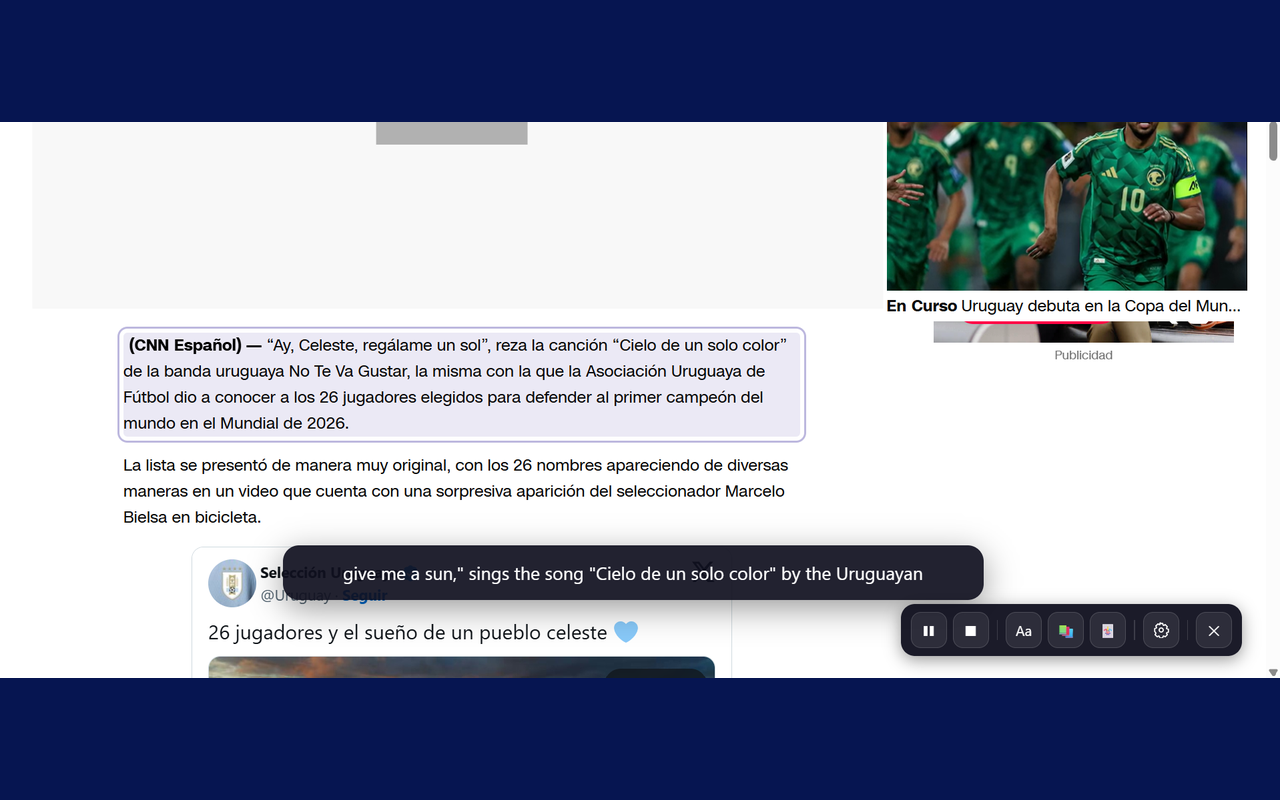
That reading half is why Verbally exists. It reads any Spanish web page aloud in Spanish with English captions in sync underneath, so a news story, a podcast transcript or a review of the film you watched last night becomes practice at a pace you set, with the Spanish leading and the English there only to catch you when you fall behind.
A week that survives a real life
You do not need a study plan. You need something small enough that a bad week does not end it. This is the shape I would suggest, and the point is that none of it requires sitting down at a desk.
- One series, on the go. Stay with a single show at your level instead of sampling five. Familiar voices and repeated situations make it easier every episode, and that compounding is the whole benefit.
- A podcast attached to something you already do. The commute, the walk, the washing up. Ten minutes counts. The habit matters more than the length.
- One read-along session, sitting down. Fifteen minutes on something you chose, with the audio running and the text in front of you. This is the half that does the converting.
- A rewatch or a re-listen, once a week. Go back over something you half-understood rather than starting something new. It feels unproductive and teaches more than anything else on this list.
- A film when you feel like it. Not as homework. As the reward, and as your exposure to accents a single series will never give you.
None of this is fast. It is just the version that still exists in six months, which is the only property that actually matters.
What you can do without paying anything
Worth stating plainly, because most guides quietly assume a subscription. A large share of the best Spanish input costs nothing at all.
Free and genuinely good: the Easy Spanish channel on YouTube, with Spanish and English subtitles on every video and episodes filmed across Spain and Latin America. Peppa Pig en español, also on YouTube, for the first year. The 52-episode Destinos course, which lost its original home when Annenberg Learner shut its site down in July 2026 and now lives on the Internet Archive. Radio Ambulante, native-level narrative journalism with a full transcript for every episode. And RTVE Play, the Spanish public broadcaster, which is free but geo-blocked outside Spain.
A streaming subscription genuinely helps for series and films. It is just not where you start, and anyone telling you it is has something to sell you.
Try Verbally free and turn any Spanish page into read-along audio →