
The Best Spanish Podcasts to Learn Spanish, by Level
A podcast is the only kind of language practice that fits into a life that is already full. You do not have to sit down, book a slot, or look at anything. That is the whole appeal, and it is also the reason podcasts quietly become the practice that never quite works, because the format asks nothing of you and gives back roughly what you put in.
Below are the Spanish shows worth your ears at each level, and the one feature I would now check before subscribing to any of them. My own plateau was in Dutch rather than Spanish, so treat the recommendations as researched rather than lived, and the argument about how to use them as hard-won.
The short answer
Pick by level, then check for a transcript. Beginners want Coffee Break Spanish or Simple Stories in Spanish. Around A2 to B1, News in Slow Spanish lets you climb inside one feed. At B1 the strongest pick is the Intermediate Spanish Podcast, with the Duolingo Spanish Podcast archive as easier listening. Radio Ambulante is the reward once native speed stops frightening you. Whatever you choose, prefer a show that publishes transcripts, because audio you cannot check is audio you cannot learn from.
Why podcasts suit Spanish better than most languages
Spanish is one of the few languages where the learner-podcast market is genuinely competitive, and competition has been good for learners. There are shows pitched at every rung of the ladder, several with a decade of back catalogue, and enough of them that you can change your mind about a host without leaving your level.
That is not the case for smaller languages, where you often get one serviceable show per level and take what you are given. So the Spanish problem is not finding a podcast. It is choosing well and then actually using it, which is where most of the value gets lost.
Best Spanish podcasts for beginners (A1 to A2)
In your first year you want speech that has been deliberately slowed and vocabulary that repeats. Native-speed conversation is not a stretch goal at this stage, it is noise, and listening to noise teaches you that Spanish is impossible rather than that it is learnable.
Resist the urge to graduate quickly. Staying at a level until it feels genuinely easy is what makes the next one possible, and almost nobody does it for long enough.
Best Spanish podcasts for intermediate learners (B1 and up)
B1 is where podcast listening either becomes the best habit you have or quietly turns into background noise. The shows below all assume you can follow connected speech, and they differ mostly in how much they help you when you cannot.
The one feature to check before you subscribe: transcripts
If you take one practical thing from this page, take this. Whether a show publishes transcripts changes how much it can teach you more than the host, the topic or the level does.
Here is why. Listening produces a very specific failure: a word arrives, you almost recognise it, and then it is gone. In reading you would stop and look at it. In audio there is nothing to look at, so the word stays almost-known indefinitely, and you can hear it fifty times without ever converting it into something you own. That is the mechanism behind the strange experience of listening to hundreds of hours and improving less than you expected.
A transcript closes that loop. You catch the word on the page, see the spelling that your ear was never going to give you, and recognise it the next time it goes past. It costs seconds and it is the difference between exposure and learning.
Practically: Intermediate Spanish Podcast and Radio Ambulante publish transcripts, News in Slow Spanish builds its whole product around following the text while you listen, and the learner shows generally provide them in some form. If a show you like has none, at least look up the two or three words that kept recurring after the episode ends.
Spain or Latin America in your ears
Audio makes the regional question sharper than video does, and it is worth deciding on purpose rather than by whatever the algorithm serves you.
With a film you have faces, context and usually subtitles. With a podcast you have none of that, so an unfamiliar accent costs you far more, and the c and z sounds that separate Castilian from Latin American Spanish arrive with nothing to soften them. Give the region you are actually learning for the large majority of your listening while your ear is settling, then broaden deliberately once it has.
On this list, Intermediate Spanish Podcast is Castilian, Españolistos and Radio Ambulante lean Latin American, and News in Slow Spanish publishes both so you can switch without changing shows. If you have no particular destination, Latin American Spanish reaches more speakers, and that is as good a tiebreak as any.
Where podcasts run out, and what to put next to them
Audio has one structural limitation and no amount of choosing the right show fixes it: you cannot slow it down without making it sound wrong, and you cannot hold a sentence still while you work it out. The words go past at the speaker's pace, not yours.
So the honest role for podcasts is ear training and habit, both of which they are excellent at. What they cannot do is give you time on a specific sentence, which is the thing that actually turns a word you have heard into a word you can use. That needs reading, on material you chose, at a pace you set. I set out the full argument for why the plateau breaks that way using Dutch as the example, and none of the reasoning depends on the language.
That reading half is why I built Verbally. It reads any Spanish web page aloud with English captions in sync, so a transcript, an article, or the news story a podcast episode was about becomes something you can go through at your own speed with the audio still running. Not a replacement for the podcast in your ears on the walk to work. The other half of it.
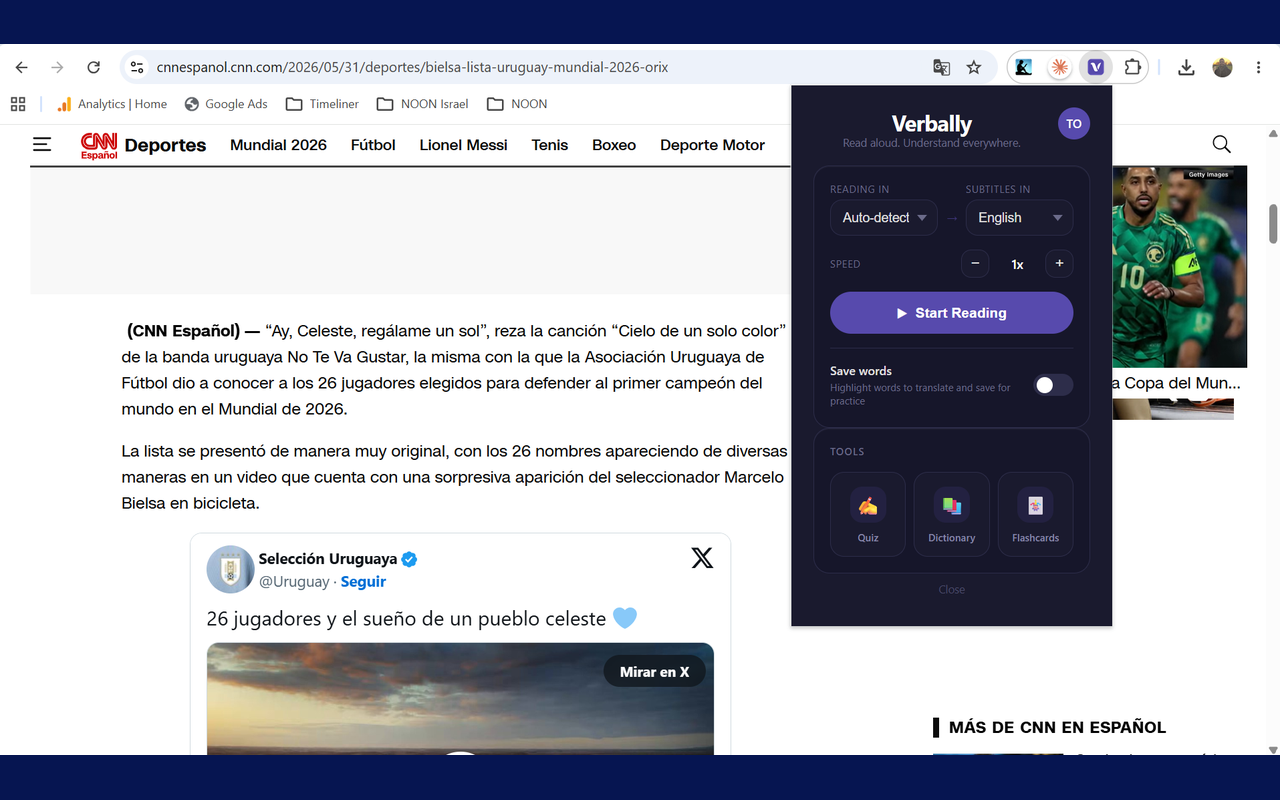
Try Verbally free and turn any Spanish page into read-along audio →