
The Best Dutch TV Shows and Movies to Learn Dutch, and How to Actually Learn From Them
For about a year I told myself that watching Dutch TV was studying. I would put on a Dutch series in the evening, switch on the English subtitles, and feel productive. Then I noticed something uncomfortable. I was reading the English the whole time. My ears were off. I could have watched the same hour with the sound muted and lost nothing, because my Dutch was doing no work at all.
Watching TV is the most enjoyable way to learn Dutch, and it is also the most overrated, because almost everyone does it the way I did. This is the guide I wish I had: the shows actually worth your time at each level, where to find them, and the one change that turns an evening on the sofa into real progress.
The short answer
The best Dutch show to learn from depends on your level. Beginners do well with slow, clear children's TV like Het Klokhuis or Nijntje. Intermediate learners around B1 want everyday conversational shows like De Luizenmoeder or Flikken Maastricht, then authentic drama like Undercover as a stretch. Whatever you watch, switch to Dutch subtitles as soon as you can, and watch on purpose rather than in the background. TV only teaches you the Dutch you actively follow.
Can you really learn Dutch from TV?
Yes, but only when the watching is active. A show you can mostly follow trains your ear for the rhythm and speed of real Dutch in a way no textbook can, and the research on watching with captions backs this up. In a 2013 meta-analysis, the researcher Maribel Montero Perez and her colleagues pooled ten studies and found that watching video with same-language captions had a medium-to-large effect on vocabulary learning. So the format genuinely works.
The catch is the word active. The same research is much less impressed by watching with subtitles in your own language while your attention wanders. If your eyes are reading English and your mind is half on your phone, the Dutch is just pleasant noise. The shows below help because they are at a level where you can follow along and stay switched on, not because TV is magic.
Best Dutch TV shows for beginners (A1 to A2)
If you are in your first year of Dutch, start with shows made for children and learners. The Dutch is slow, the sentences are short, and the vocabulary is the high-frequency words you actually need. Authentic adult TV will just wash over you at this stage, which is discouraging rather than useful.
The honest goal here is not to understand everything an adult would. It is to get comfortable with the sound of Dutch and to start noticing high-frequency words turn up everywhere once you have met them.
Best Dutch TV shows for intermediate learners (B1 and up)
Once you are around B1, children's TV starts to feel like baby talk and you are ready for everyday adult Dutch, as long as it is the conversational kind rather than fast literary drama. This is the level where most expats get stuck, so the choice matters.
When B1 starts to feel comfortable, push into authentic drama like Undercover or Anne+ on Netflix. These run at native speed with native slang, so they sit at the harder end of the scale. The day you can follow one of them without leaning on the subtitles is the day you know the plateau is behind you. That stretch zone, where you catch most of it and have to reach for the rest, is what the linguist Stephen Krashen called comprehensible input: we make the most progress on language we can almost but not quite follow.
Dutch films worth watching (and how to pick them)
Yes, you can learn Dutch from films, but they are harder than series and they work differently. A film gives you one sitting with no returning cast, no familiar setting, and no second episode to reuse what you just learned. Choose films with contemporary everyday speech, and rewatch the ones you like.
Films are a reward, not a ramp. With a series you get repetition for free: the same voices, the same kitchen, the same running jokes, and by the fourth episode your ear has quietly adjusted. A film gives you ninety minutes with strangers and then it is over. I use films as the thing I earn after a few weeks of series, not the thing I start with.
Two rules do most of the work when you pick one. Prefer contemporary speech over period drama, because a film set in 1888 teaches you a register nobody speaks at the bakery. And prefer standard Dutch over strong regional accents until your ear is steady, which is a real trap here and I come back to it below.
Two popular Dutch films to skip while you are learning
Both of these are good films. Neither will do what you want it to do right now, and one of them is the single most common wrong turn a learner takes here.
De Beentjes van Sint-Hildegard. It was the best attended Dutch film of 2020, so it comes up constantly in recommendation lists, including lists aimed at learners. It is mostly spoken in Tweants, a Low Saxon variety from the east of the country, not in standard Dutch. If you are still building your ear, an hour and a half of a regional variety will not transfer to the conversations you are trying to have. Watch it once your Dutch is comfortable and enjoy it as a film.
Publieke Werken. Set in Amsterdam in 1888. The language is careful and literary and belongs to a century nobody is speaking to you in. It is a perfectly good period drama and a poor study choice.
Where to watch Dutch films
Netflix carries a rotating set of Dutch titles and is where most people find the recent ones. NPO Start has films alongside the public broadcaster's series. Pathé Thuis rents most Dutch cinema releases, and Picl is the one to know for smaller arthouse films through your local cinema. Rights move around and are region locked, so treat any single list as a snapshot and search the title directly.
Watch films the same way you watch series: switch to Dutch subtitles the moment you can bear them, and reach for the same read-along fix below when the speech runs ahead of you.
Where to watch Dutch shows (Netflix, NPO Start, YouTube)
The three places worth knowing are NPO Start, Netflix, and YouTube, and which one you reach for depends on the show and on where you are sitting.
NPO Start is the Dutch public broadcaster's streaming service. It carries most public shows, including Het Klokhuis and Flikken Maastricht, and it is free inside the Netherlands. The one snag is that you will usually hit a geo-block when you travel, so it is a watch-at-home option.
Netflix has a growing shelf of Dutch series, including Undercover and Anne+, and it lets you switch between Dutch and English subtitles easily, which turns out to matter. YouTube is free everywhere and hosts Het Klokhuis clips, plenty of Nijntje, and the whole Easy Dutch channel, so it is the easiest place to start with no subscription at all.
Dutch or English subtitles? The B1 rule
Switch to Dutch subtitles as soon as you can bear it. That is the single change that decides whether TV teaches you anything. English subtitles let you follow the story, but your eyes do all the work and your Dutch coasts along in the background.
The research is fairly clear on this. Montero Perez and colleagues found that same-language captions, so Dutch text on Dutch audio, drew learners' attention to the shape of words, helped them tell where one word ended and the next began, and built the link between a sound and its spelling. English subtitles do none of that for your Dutch, because they replace the language instead of supporting it. The simple rule: English subtitles to enjoy a show you could not otherwise follow, Dutch subtitles the moment you want it to count as practice. And when even the Dutch subtitles move too fast to read in time, that is the real limit of the format, which is the next section.
The mistake that keeps you stuck at B1: watching passively
The reason so many intermediate learners watch hours of Dutch TV and barely improve is not the shows. It is that television is built to be watched passively, and passive watching is exactly what does not move you forward.
It moves at one speed, and it is not yours. When you miss a word, the scene keeps going. By the time you have worked out what someone said, you have lost the next exchange, and on screen there is no way to stop and catch it without breaking the flow entirely.
The subtitles you can read are the wrong ones. At B1 the Dutch subtitles often go by faster than you can process, so you fall back on the English, and then you are reading a translation instead of learning the language. The text that would help you is there, but not at a speed you can use.
You cannot choose the content. You watch whatever the show decided to make. The Dutch you most want to understand, the news about your own neighbourhood or the thing your colleagues keep talking about, is never the episode on offer.
The fix: pair watching with reading you control
Here is what finally worked for me. I stopped treating TV as the whole meal and started treating it as one half of a pair: passive listening from the screen, plus active reading on content I could actually control.
The logic is simple. Watching trains your ear but gives you no control, because you cannot slow the speech down or hold a line still while you decode it. Reading gives you all the control but none of the sound. Put the two together and each one fixes the other's weakness. The screen builds your listening, and reading the same kind of Dutch, at your own pace, locks in the words you keep half-catching on screen.
This is the gap I built Verbally to fill, on the reading side. It reads any Dutch web page aloud in real Dutch and shows English captions in sync as it goes, so you can take the actual article behind a show, a Dutch news story you genuinely want to read, or a recap of last night's episode, and go through it at a speed you set, with the text holding still and a safety net the second you fall behind. The Dutch audio stays the main signal, the English is just there to catch you. It is the read-while-listening setup the subtitle research points to, except you choose the content and you control the pace, which is the one thing a TV remote cannot give you.
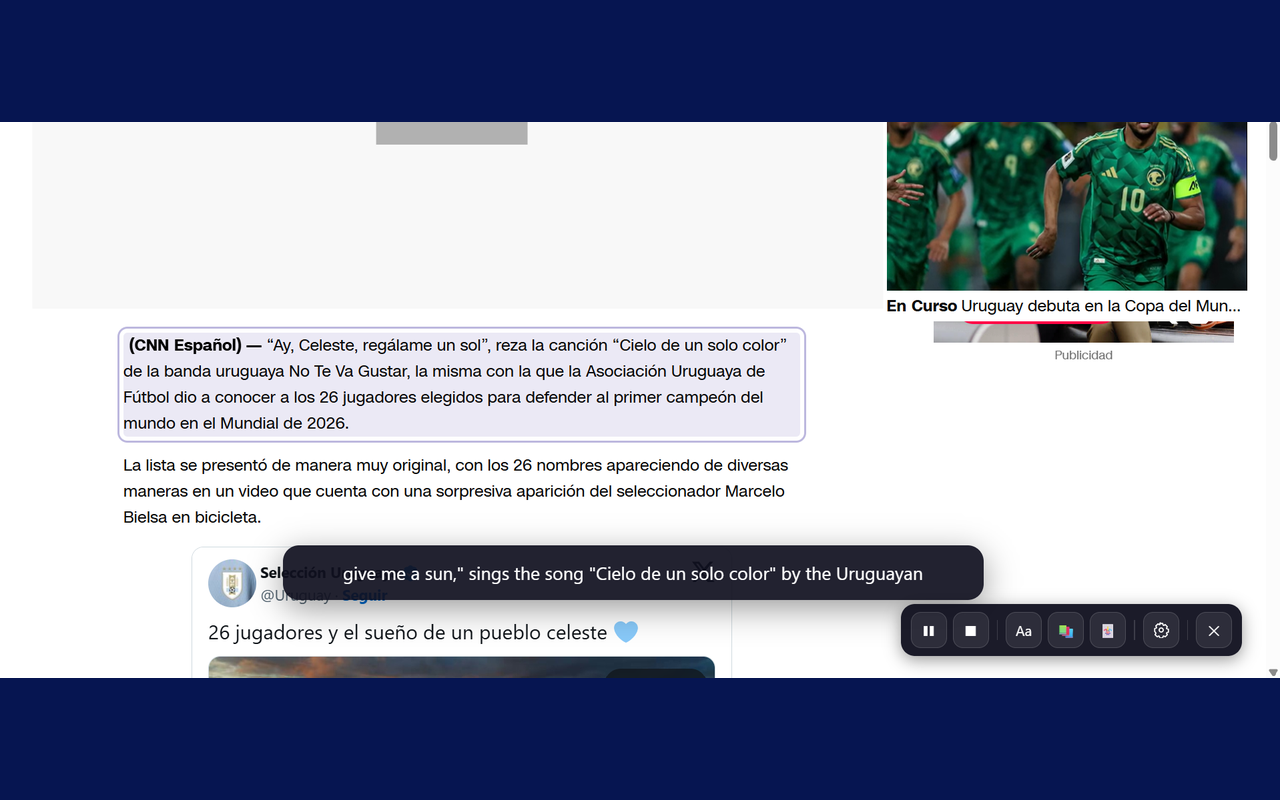
The shows are still worth it, especially for getting your ear used to real Dutch. But the watching is the easy, passive half. The progress comes from the active half next to it, and that is reading you can actually steer.
A simple weekly Dutch-TV routine
You do not need a study plan. You need a couple of habits that survive a real work week. Here is the routine I would hand my year-one self.
- Pick one show at the right level and stay with it. One series where you catch most of it beats hopping between five that lose you. Familiar characters and repeated plots make the Dutch easier every episode.
- Watch with Dutch subtitles whenever you can keep up. Drop to English only to rescue a scene you would otherwise abandon, then switch back.
- Re-watch one scene you liked. The second pass is where the words you half-caught the first time lock in. Re-watching feels less productive than new material and teaches more.
- Read around the show. Read a Dutch article about it, a recap, or the news topic it touched on, at your own pace with the audio on. This is the active half, and it is what moves the needle.
- Keep it short and regular. Twenty honest minutes most days beats a weekend binge you understand none of. Consistency is the whole game.
The plateau does not break because you found the perfect show. It breaks because you finally spent real, attentive time inside Dutch you could understand, a little every day, with a way to control the parts that move too fast.
Try Verbally free and turn any Dutch page into read-along audio →