
Stuck at B1 in Dutch? Why You've Plateaued, and the Way Out That Isn't Another App
I got to B1 in Dutch and then just stopped moving. Two years in Amsterdam, a Duolingo streak I was weirdly proud of, and I could order coffee, read a menu, follow a slow conversation if everyone was being kind. Then nothing. Month after month, same level. The streak kept going. My Dutch didn't.
If you're reading this, you probably know the exact feeling. You didn't stop trying. You stopped progressing. That's a different problem from the one you're blaming yourself for, and it has a different cause.
Here's the short version, because I wish someone had told me sooner:
The short answer
Past B1, drills stop working because the bottleneck is no longer grammar or word lists. It's the volume of real Dutch you can actually understand. You get unstuck by spending real time with large amounts of natural Dutch, listening and reading at the edge of your level, until following it stops being a fight. The hard part at B1 is finding real Dutch you can follow without burning out.
Now the longer version, and what finally worked for me.
Why am I stuck at B1 in Dutch?
You're stuck at B1 because the tools that got you here were built for the trip from zero to B1, not past it. The intermediate plateau is a well-documented stage in language learning, not a personal failing. The applied linguist Jack C. Richards even wrote a paper on it, Moving Beyond the Plateau.
Early on, every lesson adds something you can feel. Your first thousand words, the present tense, enough to survive a shop. Progress is fast because the gaps are huge and easy to fill. By B1 the easy gains are gone. What's left is the long tail: tens of thousands of words you'll meet only a handful of times, the rhythm of how people actually speak, the gap between textbook Dutch and the Dutch on the street. You can't drill your way through a long tail. There's too much of it, and a flashcard app can only keep showing you the common words you already know.
Why do apps and drills stop working here?
Apps stop working at B1 because they teach the frequent, rule-based core of a language, and by B1 you already have it. An app is a brilliant on-ramp and a poor highway.
There's a second trap if you live in the Netherlands: everyone speaks great English. The city gives you no reason to push through Dutch, so you don't, and the input that would move you forward never arrives. Your environment quietly lets you off the hook. That was the real reason my Dutch stalled. It wasn't effort. It was that nothing in my day actually required the next level.
What actually gets you past the plateau?
What gets you past the plateau is a high volume of real Dutch you can genuinely understand. Linguists have a name for this: comprehensible input, the idea that you absorb a language by understanding messages a little above your current level, not by memorizing rules about them. Stephen Krashen put this at the center of his Input Hypothesis in the 1980s, and it's been one of the most influential ideas in language learning ever since.
The key word is comprehensible. Native content only helps if you understand most of it as it goes by. A little above your level pulls you forward. Far above your level is just noise you tune out. So the real challenge at B1 is not "find harder Dutch." It's "find real Dutch you can actually follow."
Then why is reading Dutch news so exhausting?
Real Dutch news is exhausting at B1 because the distance between a learner's level and what a journalist writes for adults is enormous, and closing it word by word with a dictionary drains you before you finish one article. You open a NU.nl story, hit an unknown word in the first line, look it up, lose the thread, look up the next one, and twenty minutes later you've read one paragraph and you're done.
This is the exact moment most people quit and switch back to the English version. I did, for months. It feels responsible ("I'll come back to it when my Dutch is better"), but your Dutch doesn't get better, because the thing that would improve it is the thing you just closed.
The way out: read and listen at the same time, on the real article
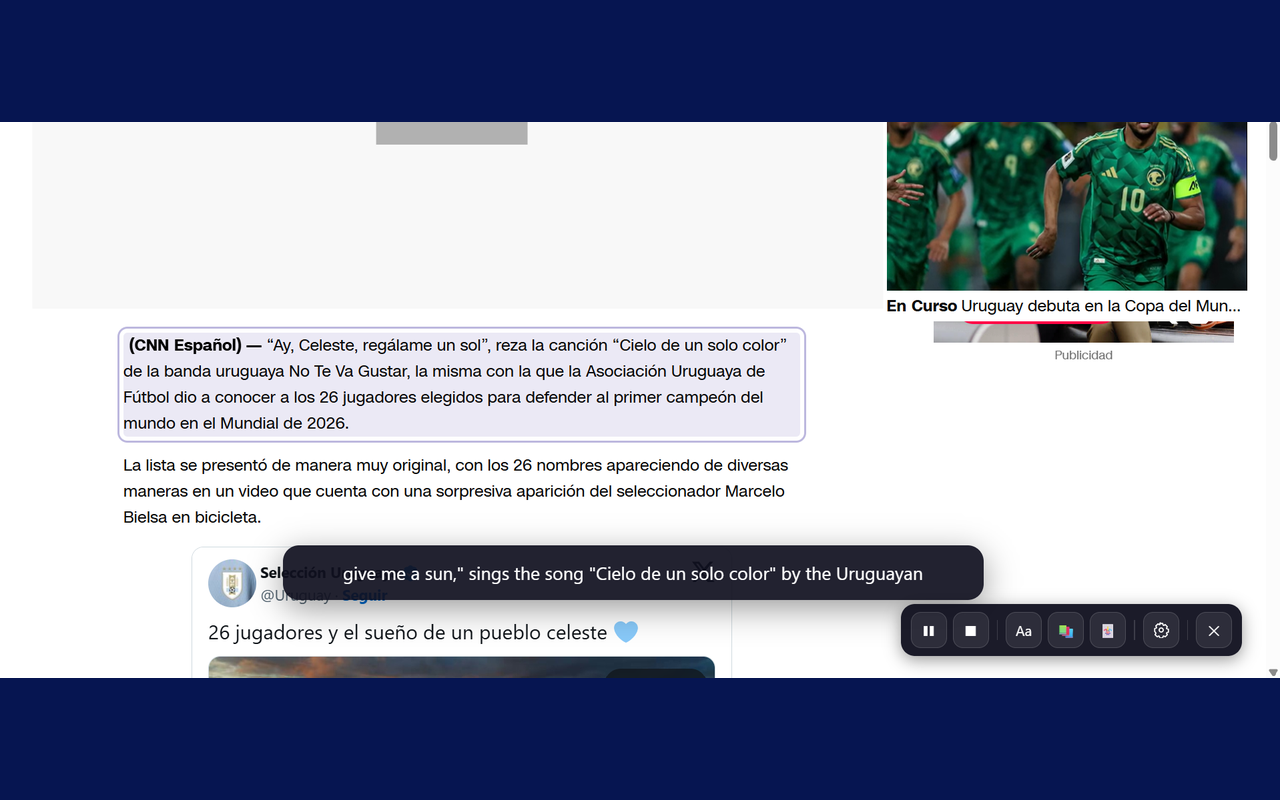
The thing that finally moved my Dutch was reading real articles while listening to them, with an English caption underneath for the moments I got lost. Three things happen at once. You hear the rhythm and pronunciation that reading silently skips. You read along, so you can't drift off. And the translation sits right there as a safety net, so one hard sentence doesn't end the whole session.
The article stays real. You're not reading a simplified rewrite for learners (those exist, and they're fine, but they're not the Dutch you'll actually meet). You're reading the same NU.nl story your colleagues read, and understanding it.
That is exactly why I built Verbally. I wanted to read the actual news and my actual letters from the gemeente, not a watered-down version, without drowning in a dictionary. Verbally reads any web page aloud in Dutch with English captions in sync, right on the page you're already on. No copy-pasting into three tabs, no separate app to load articles into. You open the article, press play, and follow along.
Can you get past B1 without a class?
Yes, you can get past B1 without a class, as long as you replace what the class gave you. A class offers two things: a forcing function that makes you show up, and feedback. Three of the four languages I speak, I learned without a classroom, so I'm living proof the room is optional. But the input is not.
Recreate the forcing function with a small daily reading habit (same time, same kind of article), and get your feedback from the content itself: when you can read a story today that would have wiped you out a month ago, that's the signal. You don't need a teacher to tell you you're moving.
How long does it take to get from B1 to B2?
Honestly, it depends, and anyone who gives you a clean number is guessing. Cambridge English's guided-learning-hours estimates put somewhere around 150 to 200 hours of study between B1 and B2, but the variable that matters most is how much real input you get, and how often. Regularity beats intensity. An hour of news three times a week beats a heroic weekend you never repeat.
How to start tomorrow, for free
Start with one short article you'd actually want to read. Pick a NU.nl or Het Parool story you already half-know from the English headlines, so context carries you. Read it, listen to it, and let the captions catch you when you slip. Ten minutes. Tomorrow, another one.
If you want the read-and-listen-with-a-safety-net setup without building it yourself, that's what Verbally does, and there's a free 3-day trial so you can try it on a real Dutch article before you pay anything.
The plateau isn't the end of your Dutch. It's just the point where the method has to change. Mine changed the day I stopped studying Dutch and started reading it.
Try Verbally free on a real Dutch article →