
The Best Spanish Movies to Learn Spanish, by Level
Most lists of films for Spanish learners will not tell you the first useful thing about films, which is that they are a worse place to start than a series and almost every learner reaches for them first anyway. A film is two hours of strangers you will never hear again. A series is twenty hours of the same four voices.
That does not make films a waste. It makes them the reward rather than the training, and there are a handful worth planning an evening around. Here they are, sorted by level, with the honest caveats about dubbed animation and about how quickly films disappear from streaming.
The short answer
Films work best once a series has done the groundwork. Start with No se aceptan devoluciones for clear Mexican Spanish, or Roma because it is slow and sparing with dialogue. At B1 move to El secreto de sus ojos from Argentina or El hoyo from Spain, then Volver as a stretch. Watch with Spanish subtitles, rewatch the one you liked rather than starting a new one, and remember that a dubbed film's subtitles will not match its audio.
Why films are harder than series, and what that means for you
The advantage a series has is repetition, and it is a large advantage. Across a season you hear the same actors with the same accents saying the same twenty situations in slightly different ways, and your ear adapts to a narrow target. By episode six you are understanding people who were incomprehensible in episode one, and none of that came from studying.
A film gives you none of that. New voices, new accent, often a period setting or a regional dialect, and then the credits roll before your ear has tuned. This is why learners frequently conclude they have gone backwards after a film, when what actually happened is that they removed the one thing that was helping them.
The practical consequence: treat films as something you spend a specific evening on, not as your main input. And when you find one you like, watch it twice. The second viewing of a film you half-understood is worth more than a first viewing of something new, and it is the least popular advice in language learning.
Best Spanish films for beginners (A2 to B1)
At this level you want clear diction, a story that carries you past the lines you miss, and ideally not too many words per minute. Comedy tends to be harder than it looks, because jokes move fast and rely on wordplay.
Best Spanish films for intermediate learners (B1 and up)
Here you can take on real speed and accents that are not chosen for your convenience. Each of these gives you a distinctly different Spanish, which is the main reason to reach for films at all.
Does watching Coco in Spanish count?
Dubbed animation is the most common shortcut on lists like this one, and it deserves a straight answer rather than a quiet inclusion.
So: enjoyable, useful for ear training, and fine as easy listening. But do not treat the Spanish subtitles as a transcript of the Spanish audio, because they are not, and noticing a mismatch you cannot explain is a fast way to lose confidence in your own listening. If you want audio and text that genuinely match, watch something originally made in Spanish. The same trap in more detail sits on the Spanish TV shows page, where it matters even more.
Where to watch, and why films vanish faster than series
Netflix is the most dependable option here, largely because two of the films above are its own titles rather than licensed ones. Its Spanish subtitle tracks are also consistently available, which is not a given elsewhere.
One thing worth understanding about film availability: streaming services usually license films for fixed terms and own their series outright. That is why the film you bookmarked has gone in three months while a Netflix original series stays for years. Any list of Spanish films with confident platform labels, this one included, is out of date somewhere. Check a regional availability tracker for your own country before you plan the evening.
How to actually watch a film so it teaches you something
Two hours of Spanish film with English subtitles is entertainment, and there is nothing wrong with entertainment. If you want it to count, three things change the outcome.
Spanish subtitles, from the start. Not English, and not off. The text pins each sound to a spelling and shows you where words end, which is the thing a translation cannot do for you.
Rewatch, do not advance. The second pass through a film you liked is where the half-caught lines resolve. It feels less productive than picking something new, and it teaches considerably more.
Read around it afterwards. An interview with the director, a review in Spanish, the news story behind the plot. That is where the vocabulary you just half-heard turns into vocabulary you can use, because reading lets you sit on a sentence for as long as it takes. I set out the full argument for why input needs that second half using Dutch as the worked example; the mechanism is not language-specific.
That reading half is what I built Verbally to handle. It reads any Spanish web page aloud with English captions in sync, so a review of the film you just watched becomes practice at whatever pace you set, with the Spanish audio leading and the English there only to catch you.
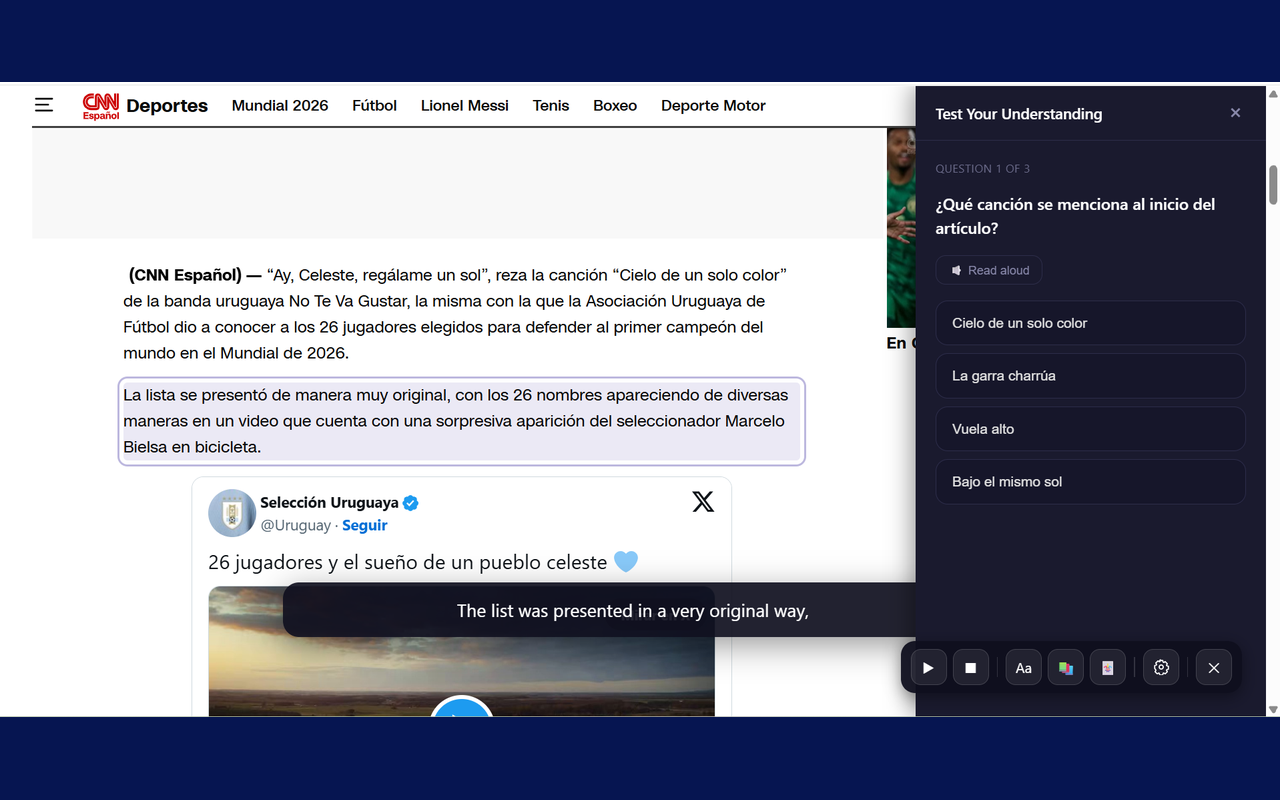
Try Verbally free and turn any Spanish page into read-along audio →