
How to Read Dutch News as a Learner (Without Falling Back on the English Version)
The Dutch election was all anyone talked about for weeks. My colleagues had opinions, the man at my coffee place had opinions, the building group chat had opinions. I had the version I had read on DutchNews.nl, in English, the night before. I could follow the conversation, more or less, but I was always half a step behind, translating in my head, never quite in it.
Here is what bothered me. I had been in Amsterdam two years. I was supposedly B1. And the actual Dutch news, the thing everyone around me was reading, I still could not read. I would open a NU.nl story, hit a wall of dense Dutch by the second sentence, and quietly switch to the English coverage. Informed, but on the outside.
If you live somewhere you are still learning the language, you know this feeling. So here is the short version first.
If you live in the Netherlands and want to follow the news but your Dutch is not strong enough yet, you have three real options. You can read English-language Dutch news like DutchNews.nl or NL Times and stay informed. You can ease in with simplified, slow Dutch news written for learners. Or you can read the real Dutch articles with a read-aloud and inline-translation tool, so the news itself becomes your practice. Most people pick the first option and never leave it. This is about how to reach the third.
Now the longer version, and what finally worked for me.
Why do you keep reading Dutch news in English?
You keep reading it in English because it works, and that is exactly the problem. The English version hands you the information instantly, with zero friction, so every single day the rational choice is to take it. And every day you take it, your Dutch stays precisely where it is. Reading the news in English keeps you informed and leaves your Dutch untouched, because the language you practice is the language you read, not the language the story originally happened in.
Being informed and making progress are two different things, and the English version quietly trades the second for the first. It even feels responsible. I will come back to the Dutch when my Dutch is better, you tell yourself. But your Dutch does not get better, because the input that would improve it is the thing you just closed. Two years of that and you are perfectly up to date and stuck at the same level.
So which should you read? Read English when you genuinely just need the facts before a meeting. Read Dutch when you want the language. The mistake is using "I have to stay informed" as the reason to never once read the Dutch.
Where can you actually read Dutch news as a learner?
There are three realistic ways to follow the news while you are still learning, and they are not equal. One keeps you informed, one eases you in, and one actually moves your Dutch.
English-language Dutch news. Sites like DutchNews.nl, NL Times, and IamExpat cover the Netherlands in clear English. They are genuinely good, and they are the right tool when you need to know what happened. For your Dutch, though, they do nothing, because there is no Dutch in them.
Simplified or slow Dutch news. There is real Dutch written for learners, with smaller vocabulary and slower delivery, plus things like the NOS Jeugdjournaal aimed at younger readers. This is a good on-ramp, and I will come back to where it runs out.
The real article, with support. The third option is to read the same NU.nl or Het Parool story everyone else reads, but with help: the audio playing as you read, and a translation within reach for the moment you lose the thread. It is the hardest to set up on your own and the most direct, because the thing you are practising is the real thing.
Does "easy Dutch news" actually work?
Yes, simplified Dutch news works, up to a point. Slow or easy news keeps the input comprehensible, which is exactly what you need early in intermediate, and that makes it a genuinely useful place to start. But it has a ceiling. It is not the Dutch you will actually meet, so at some stage you have to leave the walled garden and read the real thing.
Here is the catch nobody mentions. Simplified content gets its simplicity by smoothing out the hard words and the natural phrasing, the exact things that make real Dutch hard. So the gap between learner-Dutch and the Dutch on NU.nl does not close by reading more learner-Dutch. It closes by reading the real Dutch, with enough support that you can still follow it. Simplified news is a ramp, not a destination. Use it, then leave it.
How do you read real Dutch news when it's still too hard?
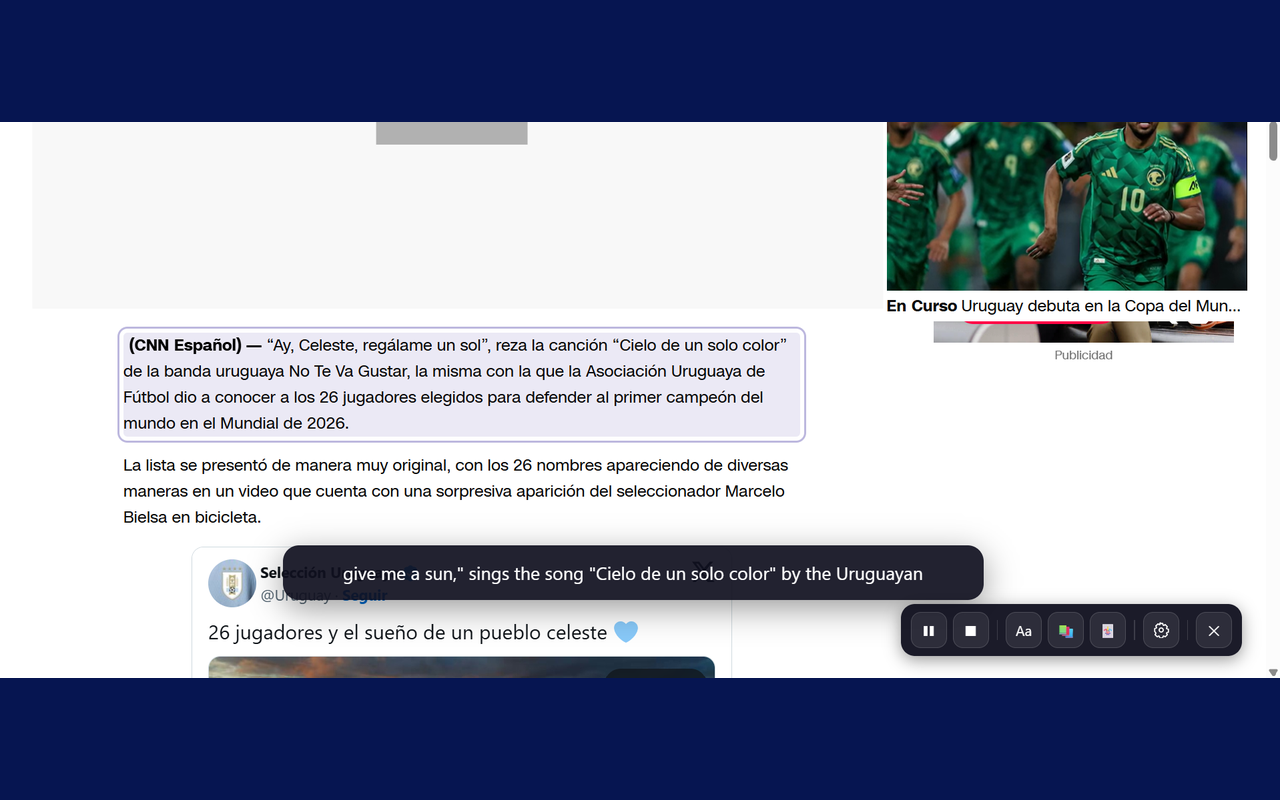
You read it before you feel ready by adding support, so the article stays comprehensible at a level you could not handle alone. Read it while listening to it, and keep a translation you can glance at the second you get lost. That is the whole move: it lets you read the real story now, instead of waiting for a someday when your Dutch is finally good enough.
What worked for me was four small things:
- Read what you already care about. Pick a story you half-know from the English headline, so context carries you through the hard sentences.
- Read and listen at the same time. Hearing it as you read catches the pronunciation and rhythm that silent reading skips, and it stops you drifting off.
- Keep a translation within reach. A safety net for the one sentence that would otherwise end the session, not a crutch you lean on for every word.
- Little and often. Ten minutes on one real article beats an hour you do once and never repeat.
This is just comprehensible input applied to the news. The idea, which Stephen Krashen put at the centre of his Input Hypothesis in the 1980s, is that you absorb a language by understanding messages a little above your current level. Real news is normally well above a B1 learner's level. Support is what pulls it back down into the range where it teaches you something.
That is exactly what I built Verbally to do. It reads any web page aloud in Dutch with English captions in sync, right on the page you are already reading, so you press play on the actual NU.nl story instead of pasting it into three other tabs. It is one way to do the third option, and there is a free 3-day trial so you can try it on a real article before paying anything.
What level do you actually need to read Dutch news?
Lower than you think, as long as you have support. To read a text comfortably on your own, you need to know around 98% of the words in it, a threshold from Hu and Nation's well-known 2000 study on reading comprehension. Real news sits well below that line for a B1 learner, which is why it feels impossible unaided, and why support changes the maths.
Ninety-eight percent coverage means about one unknown word in fifty. A typical news article for a B1 reader is more like 90 to 95% known, which is several unknown words per sentence, and that is precisely why one NU.nl story leaves you exhausted. You have two ways across that gap. You can spend a year or two grinding your vocabulary up until the real news is comfortable unaided, or you can add support that fills the missing few percent for you right now, so you read real news today and grow your vocabulary from the news itself. The second route is faster and far less miserable. You do not need to be ready. You need to be supported.
Make it a daily loop, not a project
The way this sticks is by being small and daily, not a big push you brace for. One real Dutch article a day, read and listened to, does more than a heroic Sunday session you never repeat. Research on extensive reading is blunt about this: reading a regular volume of text you mostly understand is one of the most reliable ways to build a language, and the benefits spill over into writing and speaking too (Day and Bamford, 2002).
The nice part is that you already read the news. You are not adding a class to your week or a course to your evenings. You are taking ten minutes you already spend and doing them in Dutch instead of English. Same time each day, same kind of story, so it becomes a habit rather than a decision. If you are stuck at B1 and not sure why nothing is moving, this daily input is the missing piece. I wrote about why the intermediate plateau happens, and the way out that isn't another app, if you want the longer story.
You do not have to choose between staying informed and actually learning Dutch. Read the story everyone is talking about, in Dutch, with the audio and a caption to catch you when you slip. That is the whole idea behind Verbally, and the free 3-day trial lets you try it on today's NU.nl before you pay anything.
Try Verbally free on a real Dutch article →