
Readlang vs LingQ vs Verbally Reader: an honest comparison for reading real articles
I should say this first: I make one of these three. I built Verbally Reader after I stalled at B1 in Dutch, two years into living in the Netherlands, so treat me as an interested party and check anything that matters to you. I have tried to write the page I wanted when I was the one comparing tools, which means telling you plainly when one of the other two is the better buy. For a lot of people it will be.
The short answer
Readlang, LingQ and Verbally Reader solve three different reading problems. Readlang is the lightest way to click-translate any web page. LingQ is the deepest content library and vocabulary tracker. Verbally Reader is the only one of the three that reads the page aloud in the language you are learning with a synced translation underneath. Pick by which one your reading actually stalls on.
Pick by where you get stuck, not by the feature list
Feature tables are how these comparisons usually go, and they are close to useless, because every one of these tools can show you the meaning of a word. What separates them is which kind of stuck they fix.
That last row is real. If you are already reading comfortably and only meet a hard word now and then, a free click-to-translate tool is enough, and none of us should be taking your money.
What each one actually is
Readlang is a browser extension and web reader. You open a page, click a word, and the translation appears inline. Words you click get saved and come back as flashcards. It has been around a long time and it is deliberately small in scope.
LingQ is a full study platform built around a content library. You read inside LingQ's own reader, either its material or things you import, and it tracks every word you meet in one of a few states: new, learning, known. That vocabulary count is the centre of the product, and for some people it is the whole reason to use it.
Verbally Reader is a Chrome extension that turns a page you were already reading into a listening and reading session. It reads the page aloud in the language you are learning with a translated caption line moving underneath in sync. You save words as you meet them and review them later as flashcards, and you can take a comprehension quiz written by AI about that specific article, at three difficulty levels. Nine languages, and any of the nine can be the one you are learning, English included.
Where Readlang wins
Speed and simplicity. There is nothing to set up and nothing to learn. You are on a page, you click a word, you keep reading. That is the entire product and it is very well judged.
Its free tier is also genuinely generous in the place that matters most: unlimited single word translations, with 10 phrase translations and 10 context explanations a day on top (Readlang pricing). Most people who just want to know what a word means will never hit that ceiling.
And it supports far more languages than either of the others. Readlang added 58 languages in one go in 2024, bringing it past 100 (Readlang blog). If you are learning something outside the common European set, this is very likely your only option of the three, and that decides it.
Where LingQ wins
Depth, and the fact that it has been doing this for well over a decade. Two things it does that neither of the others comes close to.
First, the library. If your problem is that you do not have anything at the right level to read, LingQ hands you graded material with audio already attached. Verbally Reader has no library at all and never will, because the whole idea is that you bring your own page. If you do not have a page you want to read, we are the wrong tool and LingQ is the right one.
Second, the tracking. LingQ's known-word count follows you across everything you read, for years. People who like that number really like it, and it is a legitimate way to see progress on a timescale where progress is otherwise invisible. Neither Readlang nor Verbally Reader offers anything comparable.
LingQ supports 52 languages (LingQ), and it is the most expensive of the three.
Where Verbally Reader wins
One thing, and it is the thing the other two do not do: it reads the page out loud in the language you are learning, in a neural voice, with the translation running underneath in sync.
That matters if your listening is behind your reading, which for self-taught learners it almost always is. I could read Dutch news well before I could follow two colleagues talking, because I had only ever met the language on a page. Reading silently in a language you are learning teaches you a version of it that nobody speaks.
The synced translation is the other half. It is there so that when you lose the thread you can glance down, catch up, and keep going, instead of closing the tab. The original language stays the main signal. That is the difference between a learning tool and a translation shortcut, and it is a line worth being careful about, because it is easy to build the second by accident.
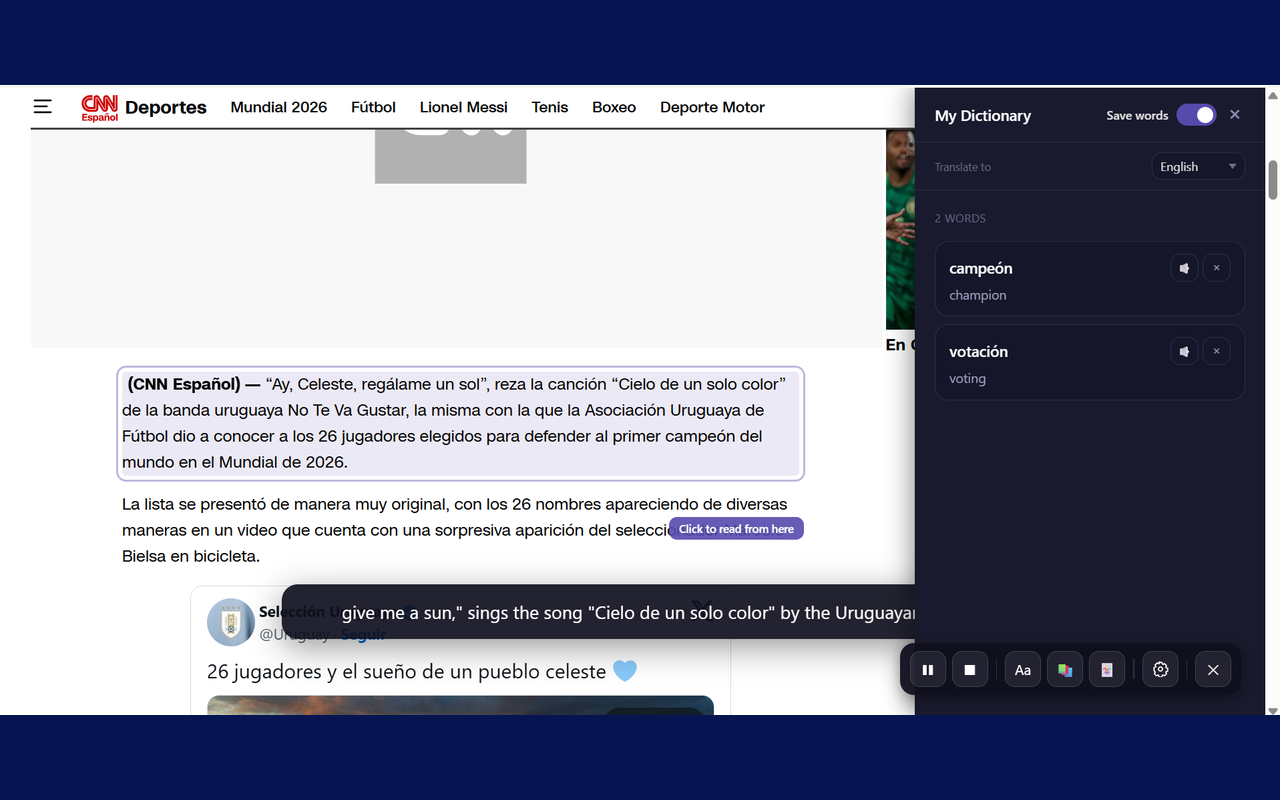
Two smaller things. The captions are translated by a language model that sees each sentence in context rather than word by word, so idiom mostly survives. And the comprehension quiz is written about the article you just read, at request time, rather than pulled from a bank, so it works on a page nobody prepared in advance.
Where Verbally Reader loses
This is the section I would want to read, so here it is without hedging.
No content library. None. If you have nothing to read, we do not help you find anything. LingQ solves this properly and we do not attempt to.
No tutors, no community, no conversation practice. LingQ has all three. If you want a place to go and people to be accountable to, we are not it.
No ebook or podcast import. LingQ imports ebooks, YouTube transcripts and audio. We work on web pages. If your reading is books, we are the wrong shape.
Nine languages, against LingQ's 52 and Readlang's 100-plus. If your language is not on our list, the comparison stops here and the answer is one of the other two.
No long-term vocabulary tracking worth the name. You save words and review them as flashcards. There is no known-word count following you across years. If that number is what motivates you, LingQ is the better buy and it is not close.
We are much newer and much smaller. Readlang and LingQ have both been running for well over a decade with real teams. Verbally Reader is a side project I build on my own. That means faster changes and a direct line to the person who wrote it, and it also means less polish, fewer edge cases handled, and the ordinary risk that comes with any small product.
Nothing adapts to you. The quiz difficulty is a button you press. The product does not learn your level, build a curriculum, or personalise anything over time. Some people will read the AI in these tools as more than that. It is not.
Try Verbally Reader on a page you were already going to read →
If you already pay for one of these
Most people reading a comparison already have a subscription, so this is the useful question, and the honest answer is usually "stay where you are".
If you pay for LingQ and you use the library, stay. The library is the product and you would be giving up the thing you are paying for. There is no version of this where swapping saves you anything.
If you pay for LingQ and you never touch the library, look again at what you are using. A lot of people pay for LingQ and spend all their time on imported articles they found themselves. That is a real pattern and it is worth checking your own usage before renewing, whatever you switch to.
If you pay for Readlang and it is working, stay. Readlang is cheaper than LingQ, does its one job well, and the only reason to move is if you have realised the gap is listening rather than vocabulary.
Running two tools is fine and quite common. These are not mutually exclusive. Reading with one and listening with another is a reasonable setup, and nobody should pretend otherwise to win a comparison.
Price and free tiers
Prices checked 22 September 2026. All three change these, so confirm before you buy.
LingQ's free tier is a demo rather than a usable free plan, by their own description: 20 saved words total is reached in a single article. Readlang and Verbally Reader both have free tiers you can genuinely keep using, and they are capped differently, which is the part worth understanding. Readlang caps what you can do to a page and never expires: unlimited single words, then 10 phrase translations a day. Verbally Reader caps how many articles you read, at 15 a month, and the count resets. So Readlang suits dipping into many pages for single words, and Verbally Reader suits working properly through a handful of articles a month. Neither is unlimited, and anyone telling you their free tier is unlimited is selling something.
How to choose in one minute
Ask what stopped you last time you tried to read something real in the language you are learning.
If you stopped because you did not know the words, Readlang. If you stopped because you had nothing worth reading, LingQ. If you got through it on the page but could not have understood a word of it spoken aloud, that is the gap Verbally Reader was built for, and it is the one I built it for in myself after I hit a wall at B1 in Dutch.