
Dutch · Learning
The Best Way to Learn Dutch When You're Past the Basics
Search "best way to learn Dutch" and you get the same answer every time. Duolingo, a course, maybe Babbel, a list of podcasts, a tutor if you're serious. I worked through most of that list. I got to B1, and then I just stopped moving. Two years in Amsterdam, a streak I was proud of, and my Dutch sat exactly where it was.
So this is not another list of apps. The apps are fine. The problem is that "best way to learn Dutch" has two different answers depending on where you're standing, and almost every article only gives you the beginner one.
The best way to learn Dutch depends on your level. To get started, a structured app or course is genuinely the fastest on-ramp. To get good, past the beginner stage, the best way is a high volume of real Dutch you can actually understand, read and heard every day, a little above your level. Beginner tools teach the core. Real input takes you the rest of the way. Most people stall because they keep using the on-ramp long after they've left the on-ramp.
Here's the longer version, level by level, and what actually moved my Dutch.
The "best way to learn Dutch" everyone tells you (and where it stalls)
The standard advice is right for the first stretch and wrong for the rest. An app or a beginner course is the best way to start: it gives you the frequent words, the basic grammar, and a routine, in the right order, without you having to think about it. For zero to roughly A2, it's hard to beat.
Then it stalls, and not because you stopped trying. Beginner tools teach the common, rule-based core of the language, and once you have that core, they keep showing it to you. You drill the same thousand words and the same present tense while the actual language, the way people write and speak, sits somewhere you never go. The method that got you in is now the thing keeping you in place. That is the moment to change methods, and almost nobody tells you that.
Why do English speakers get stuck learning Dutch?
English speakers get stuck learning Dutch for one reason above all the others: in the Netherlands, everyone speaks English back to you. The country gives you no reason to push through Dutch, so you don't, and the daily input that would move you forward never arrives.
This is the trap that's specific to Dutch. Your Spanish-learning friend in Madrid is forced into Spanish at the bakery. You order your coffee in Dutch, the barista clocks your accent, switches to flawless English, and the conversation is over before it started. It feels like your effort is the problem. It isn't. Your environment quietly lets you off the hook every single day. That, not laziness, is why so many people live here for years and stay at B1.
What actually works past the beginner stage
What works past the beginner stage is comprehensible input: large amounts of real Dutch you understand most of as it goes by. This is the idea that you absorb a language by understanding messages slightly above your current level, not by memorizing rules about them. Stephen Krashen put it at the center of his Input Hypothesis in the 1980s, and it has been one of the most influential ideas in language learning ever since.
The load-bearing word is comprehensible. Dutch far above your level is just noise, and you tune it out. Dutch a little above your level pulls you forward. So the real task past B1 is not "find harder Dutch." It's "find real Dutch you can actually follow." Get that, in volume, most days, and you improve almost without noticing. Skip it, and no amount of extra drilling closes the gap.
What's the fastest way to learn Dutch?
The fastest way to learn Dutch is more time inside the language, more often. Frequency beats intensity. An hour spread across the week as short daily contact does more than a heroic Sunday you never repeat, because a language is a habit your brain builds through regular exposure, not a subject you cram.
There's no shortcut around the hours, and anyone selling you "fluent in three weeks" is selling you something. What you can do is make the hours count. An hour of Dutch you understand teaches you far more than an hour of Dutch you stare at blankly or an hour of the same beginner drill. Fast doesn't come from a trick. It comes from spending your time on input that's at the right level and that you'll actually come back to tomorrow.
What's the best way to learn Dutch as an English speaker?
The best way to learn Dutch as an English speaker is to lean hard on how close the two languages already are, and to reach real content sooner than you think you can. The US Foreign Service Institute rates Dutch a Category I language, its easiest group for English speakers, alongside Spanish and French. The vocabulary overlaps, the grammar is familiar, and whole sentences are half-readable on day one.
That closeness is your advantage, so use it. You can move to real Dutch content earlier than a learner of, say, Japanese ever could, because so much of it is already within reach. The thing holding you back usually isn't the difficulty of Dutch. It's the English-everywhere environment from the last section. Get real Dutch in front of yourself daily and that head start does the work.
Can you learn Dutch by yourself, without classes?
Yes, you can learn Dutch by yourself, as long as you replace what a class actually gives you. A class offers two things: a forcing function that makes you show up, and feedback. Three of the four languages I speak, I learned without a classroom, so I know the room is optional. The input is not.
Recreate the forcing function with a small daily habit: same time, same kind of Dutch, short enough that you don't dread it. Get your feedback from the content itself. When you read something today that would have wiped you out a month ago, that's the signal you're moving. You don't need a teacher to confirm it. What you need is to keep the input coming.
The best way to learn Dutch with real content (news, articles)
The best way to learn Dutch with real content is to read it and listen to it at the same time, with a translation ready for the moments you lose the thread. Reading silently lets you skip the sound of the language. Listening alone drops you in too fast. Doing both at once, on a real article, is the version of comprehensible input that actually sticks, because three things happen together: you hear the rhythm, you read along so you can't drift, and the meaning is there to catch you when one hard sentence would otherwise end the session.
The catch at B1 is that real Dutch news is exhausting. You open a story, hit an unknown word in the first line, look it up, lose the thread, and twenty minutes later you've read one paragraph. That's the exact moment most people switch to the English version and their Dutch stops. Reading the real news as a learner is worth it, but only if you have a way to do it without drowning in a dictionary.
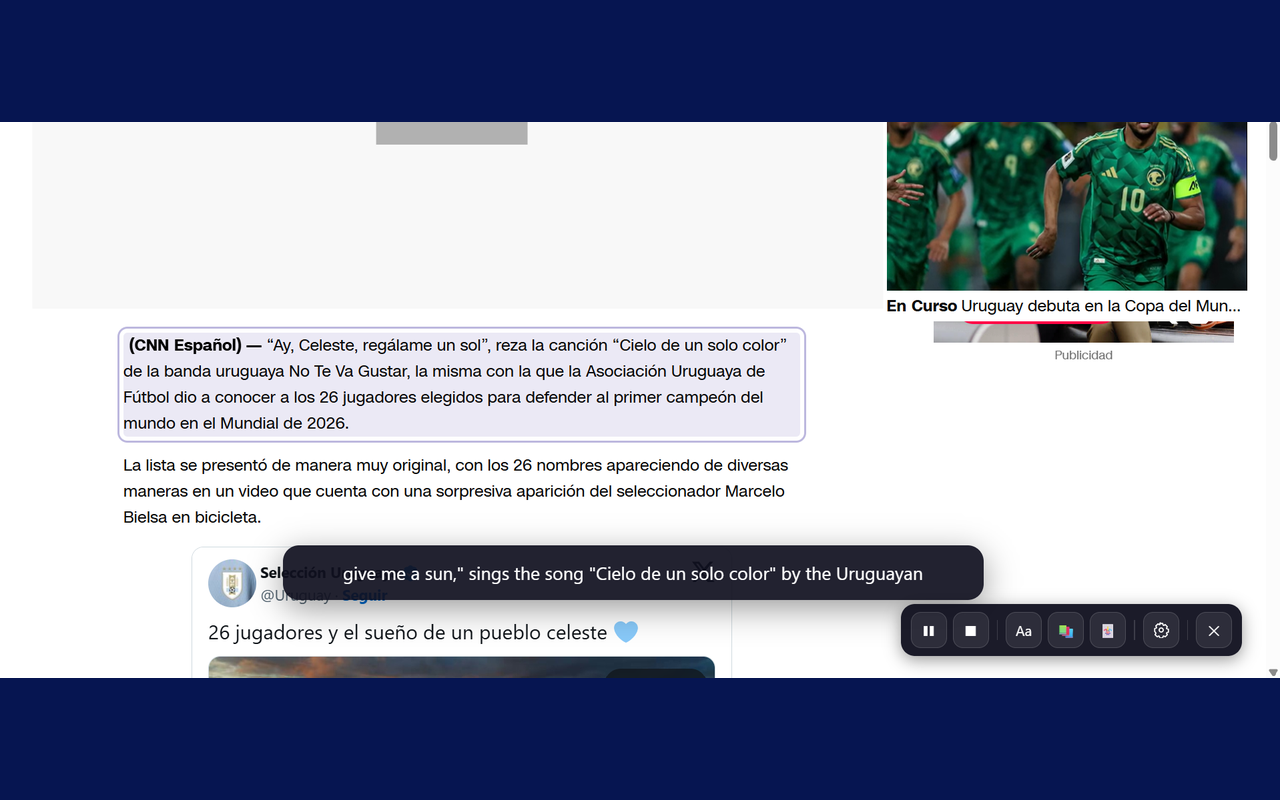
That's the gap I built Verbally to close. It reads any web page aloud in Dutch with English captions in sync, right on the page you're already reading, and you can save the words you meet to review later. You open the actual NU.nl story your colleagues are reading, press play, and follow along, instead of settling for the watered-down version. The content stays real. You just stop fighting it alone.
Is Duolingo enough to learn Dutch?
Duolingo is enough to start learning Dutch, and not enough to finish. It's a strong on-ramp for the first stretch: it builds a vocabulary base, a bit of grammar, and a daily habit, all in the right order. Plenty of people get a real foundation from it, and that's no small thing.
Where it runs out is the same place every beginner tool does. It teaches the common core, and once you have that core it can only keep showing it to you. To go past the early intermediate stage you have to leave the app and get into real Dutch, the news, articles, conversation, the messy unsimplified stuff. Use Duolingo for what it's great at, then graduate from it on purpose instead of waiting for it to take you somewhere it was never built to go.
How long does it take to learn Dutch?
It depends on where you're going and how often you show up, and anyone who gives you a clean number is guessing. For the whole journey, the US Foreign Service Institute estimates roughly 600 to 750 class hours to reach professional working proficiency in Dutch, around B2 to C1, which makes it one of the faster languages for an English speaker. For the specific climb from B1 to B2, Cambridge English's guided-hours estimates land somewhere around 150 to 200 hours.
Treat those as rough maps, not promises. The number that actually decides your pace is how much real input you get and how regularly. Steady daily contact with Dutch you understand will get you there faster than any plan built around a fixed hour count you can't keep.
What I'd do if I started over
If I started over, I'd spend less time on the app and get to real Dutch sooner. I'd use a beginner course to reach A2, treat that as the on-ramp it is, and then switch deliberately to reading and listening to real content every day, at a level I could just about follow.
I'd keep it small and daily instead of big and rare. One short article I actually cared about, read and heard, captions ready for the hard parts. Ten minutes most days. The plateau isn't the end of your Dutch. It's the point where the method has to change, and the best way forward stops being another app and starts being the language itself.
Try Verbally free on a real Dutch article →